
AI Agents vs Chatbots: Why Workflow Automation Matters
AI agents execute complex tasks autonomously, unlike chatbots that only respond to queries.
Businesses need workflow automation to unlock efficiency and drive real operational growth.
AI Agents Drive Real Workflow Automation
AI Agents Execute Tasks, Not Just Converse
Unlike chatbots that simulate conversation, AI agents autonomously execute multi-step workflows to solve specific business problems. They analyze data, make decisions, and trigger actions without constant human intervention, transforming how organizations operate.
Integrating these tools into daily operations requires a shift from simple Q&A to structured process management. Companies like GMart Automation specialize in building these intelligent systems that handle complex logistics and customer interactions seamlessly.
- Agents process unstructured data to generate actionable insights
- They execute end-to-end tasks across different software platforms
- They reduce manual errors by following precise, predefined logic
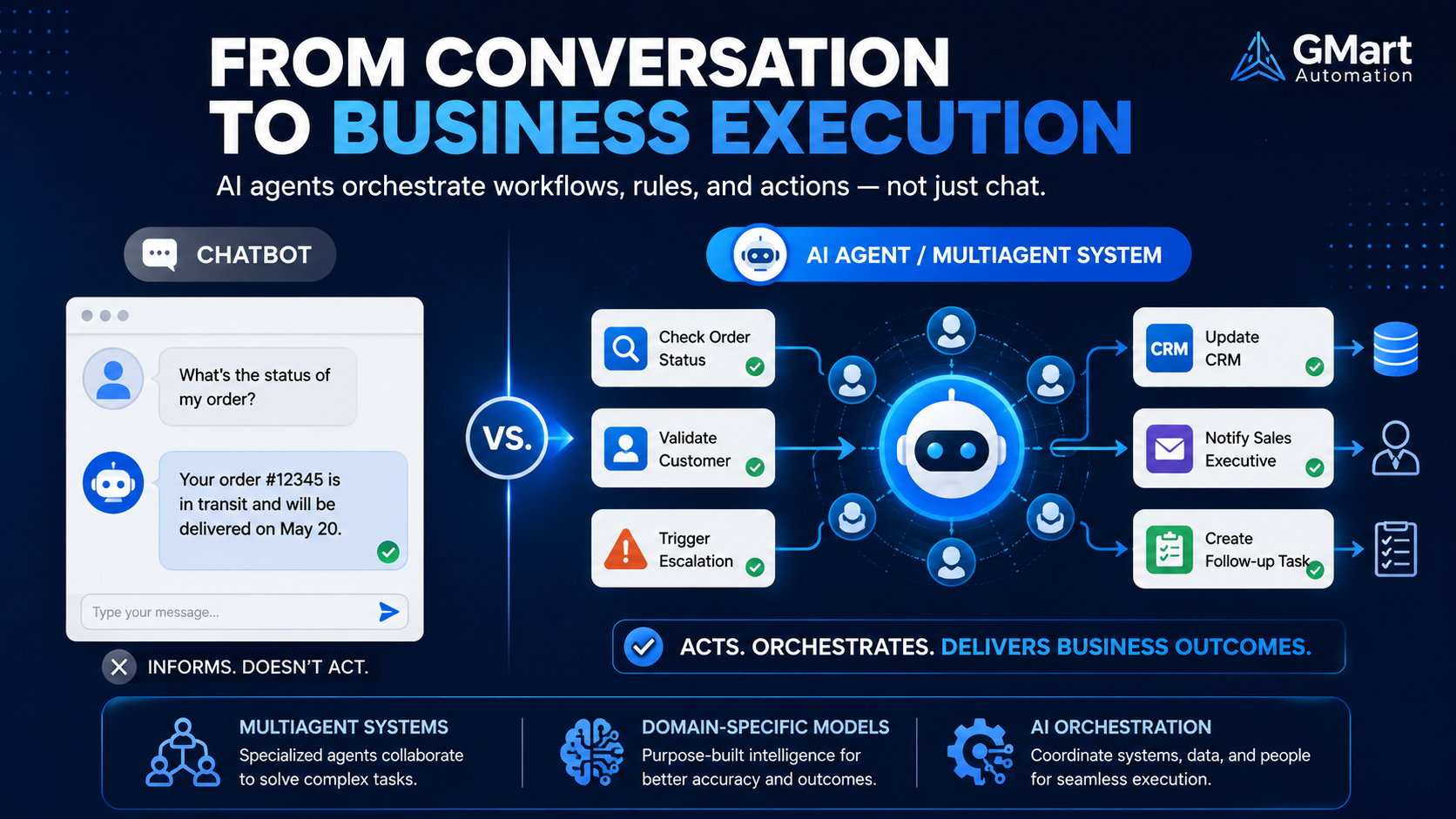
Many organizations confuse AI agents with chatbots, yet the distinction is critical for operational efficiency. While chatbots handle simple queries, AI agents execute complex, multi-step workflows autonomously, reducing manual intervention significantly.
Businesses adopting workflow automation gain real-time insights and consistent execution, directly impacting productivity metrics. For instance, GMart Automation enables seamless integration across sales and supply chains, ensuring data flows without human error. This shift transforms reactive support into proactive problem-solving, aligning with modern enterprise goals.
Key Benefits of Workflow Automation
- Reduced operational costs through automated task execution
- Improved accuracy in data processing and decision-making
- Scalable solutions that adapt to growing business needs
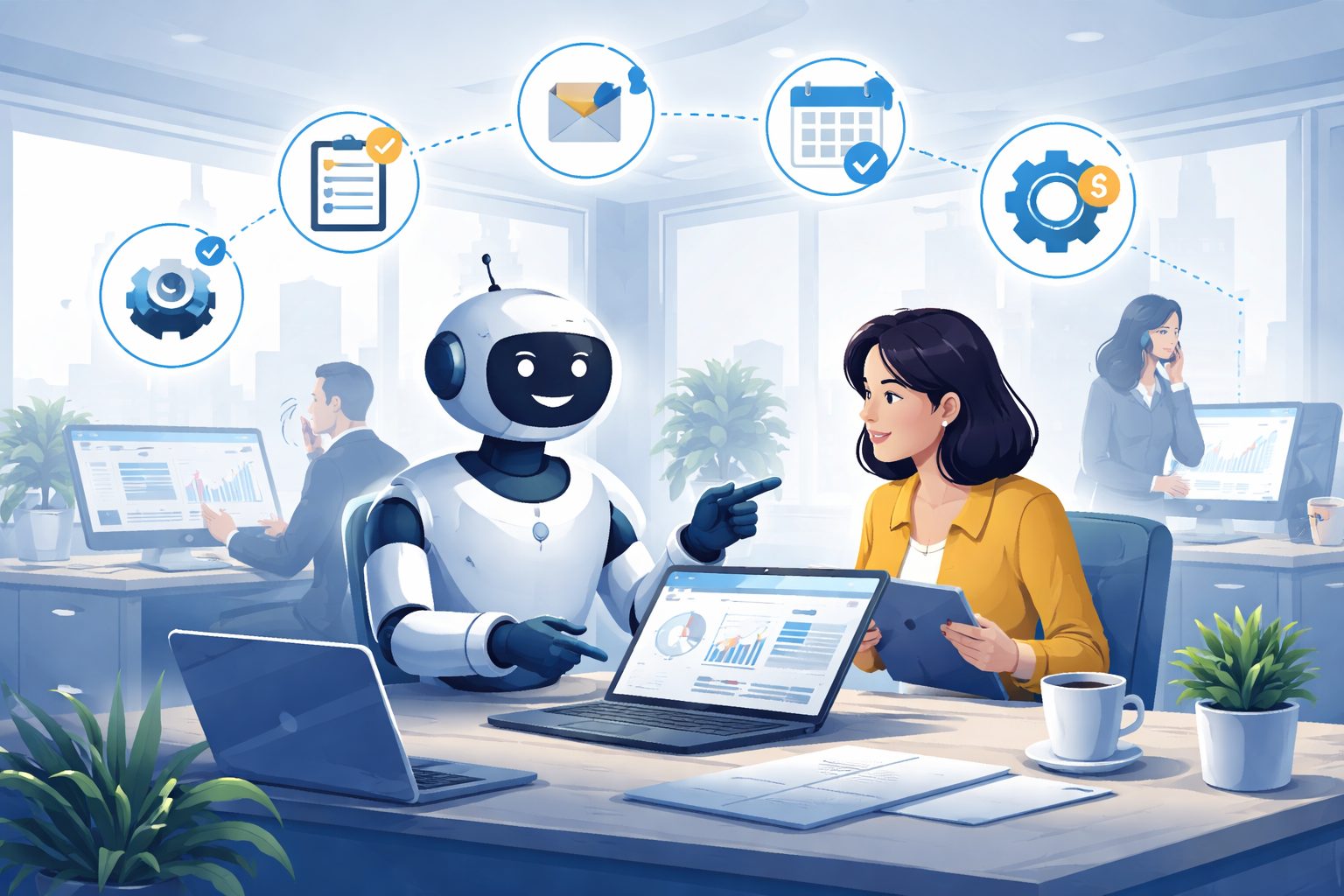
Beyond Simple Chat
AI Agents Are Not Chatbots: Why Businesses Need Workflow Automation
True AI agents execute complex workflows autonomously rather than just answering questions.
Capability
Agents execute multi-step tasks without human intervention
Process
Systems integrate data sources to drive automated decisions
Integration
Tools connect seamlessly to create unified operational flows
Outcome
Organizations achieve measurable efficiency gains through automation

AI agents differ from chatbots by executing multi-step workflows rather than just answering queries. While chatbots rely on pattern matching for single-turn conversations, agents integrate with business tools to perform tasks like data entry, report generation, and customer onboarding autonomously.
Why Workflow Automation Matters
Businesses face rising operational costs and labor shortages, making manual processes unsustainable. Automating repetitive tasks reduces errors, accelerates delivery times, and frees human teams to focus on strategic decision-making. This shift transforms IT from a support function into a strategic asset that drives revenue growth.
Real-World Impact
Companies adopting intelligent automation see up to 30% faster project completion and a 20% reduction in operational overhead. Tools like GMart Automation help orchestrate these complex workflows by connecting disparate systems, ensuring data flows seamlessly across departments without human intervention.
.jpg)
Implementation Flow
Process Steps for AI Workflows
AI agents differ from chatbots by autonomously executing complex workflows rather than just answering questions.
Define
Establish clear goals and success metrics for the agent.
Analyze
Map existing business processes to identify automation opportunities.
Build
Configure the agent with necessary tools and permissions.
Test
Validate outputs against real-world scenarios before deployment.
How AI Agents Differ from Chatbots
AI agents differ from chatbots by executing complex tasks autonomously rather than just answering queries. Businesses require systems that integrate tools and execute end-to-end processes to unlock true operational efficiency.
Unlike conversational interfaces, these agents plan, act, and learn from outcomes. GMart Automation exemplifies this shift by deploying intelligent agents that manage routine workflows without constant human intervention.
- Agents execute multi-step tasks across different software platforms
- They reduce manual data entry and processing errors significantly
- Self-learning capabilities allow continuous optimization of business processes
Why Workflow Automation Matters
Organizations adopting agent-based automation see faster time-to-market and lower operational costs. The key is moving beyond simple chat interactions to active process execution.
USE CASES
Where this applies across industries
AI agents transform operations by automating complex workflows across diverse sectors.
Healthcare
Pain: Patient intake delays
Solution: Automated scheduling and triage systems
Finance
Pain: Manual reconciliation errors
Solution: Self-healing accounting agents
Retail
Pain: Inventory tracking inefficiencies
Solution: Autonomous stock management bots
Manufacturing
Pain: Production line bottlenecks
Solution: Predictive maintenance agents
Logistics
Pain: Route optimization delays
Solution: Real-time routing automation tools
Legal
Pain: Document review bottlenecks
Solution: Contract analysis AI agents
Education
Pain: Administrative workload overload
Solution: Automated enrollment and grading bots
Real Estate
Pain: Tenant communication gaps
Solution: Smart property management agents
Agriculture
Pain: Crop monitoring inefficiencies
Solution: Environmental data analysis bots
Energy
Pain: Grid load management issues
Solution: Demand response automation agents

Comparison
Manual process vs automated workflow
Manual workflows rely on human effort and are prone to errors, while GMart Automation delivers consistent, scalable efficiency.
Key Differences
- Manual: Slower, error-prone, and lacks scalability.
- GMart: Fast, accurate, and self-correcting.
| Capability | Manual Process | GMart Automation |
|---|---|---|
| Capability | Manual limitation | GMart automation benefit |
| Data Entry | Prone to human error | Instant, error-free processing |
| Decision Making | Slow, reactive delays | Real-time, data-driven insights |
| Scalability | Limited by staff hours | Infinite, 24/7 operation |
| Consistency | Variable quality output | Uniform, standardized results |
| Reporting | Delayed, manual compilation | Instant, automated dashboards |
Beyond Simple Chats
Key Takeaways
Shift from reactive chats to proactive workflow automation.
Replace manual tasks with intelligent agent-driven processes.
Build systems that execute complex business logic autonomously.
Measure efficiency gains through automated operational workflows.
FAQ
Frequently Asked Questions
Discover how AI agents transform business workflows beyond chatbots.
What distinguishes AI agents from traditional chatbots?
AI agents execute autonomous workflows and execute tasks independently, whereas chatbots primarily respond to user queries with predefined text or simple actions.
How do AI agents improve operational efficiency in retail?
AI agents automate inventory checks, reorder supplies, and manage customer follow-ups, reducing manual labor and ensuring real-time data accuracy across all departments.
Can AI agents handle complex multi-step business processes?
Yes, AI agents can sequence multiple tasks, integrate with various software platforms, and resolve complex issues without requiring constant human supervision or intervention.
What are the main benefits of replacing manual tasks with AI agents?
Businesses save significant time and reduce errors by delegating repetitive, data-heavy tasks to AI agents that operate continuously without fatigue or distraction.
How does GMart Automation help integrate AI agents into existing systems?
GMart Automation provides the necessary framework to connect AI agents with legacy software, ensuring seamless data flow and reliable execution of automated workflows.
What ROI can businesses expect from adopting AI agent automation?
Companies typically see a 30-50% reduction in operational costs and a 20% increase in task completion speed within the first six months of implementation.
Recommended Reading
Related Blogs
Explore more articles related to automation, workflows, AI, and business process improvement.

AI + BPMN: The Future of Intelligent Workflow Orchestration
How structured BPMN workflows and AI-powered intelligence work together to automate enterprise decisions, approvals, routing, document processing and operational execution.
Five Pillars of Enterprise Workflow Automation
How scalable businesses build secure, AI-ready and integration-driven operations with a modern workflow automation foundation.
From Chat to Action
Ready to Automate Your Manufacturing Workflows?
Stop treating AI as a simple chat interface. Discover how autonomous agents can execute complex manufacturing tasks, manage supply chain logistics, and optimize production lines without human intervention. Our consultation will analyze your current operational bottlenecks and demonstrate a tailored roadmap for deploying intelligent agents that drive real efficiency gains.